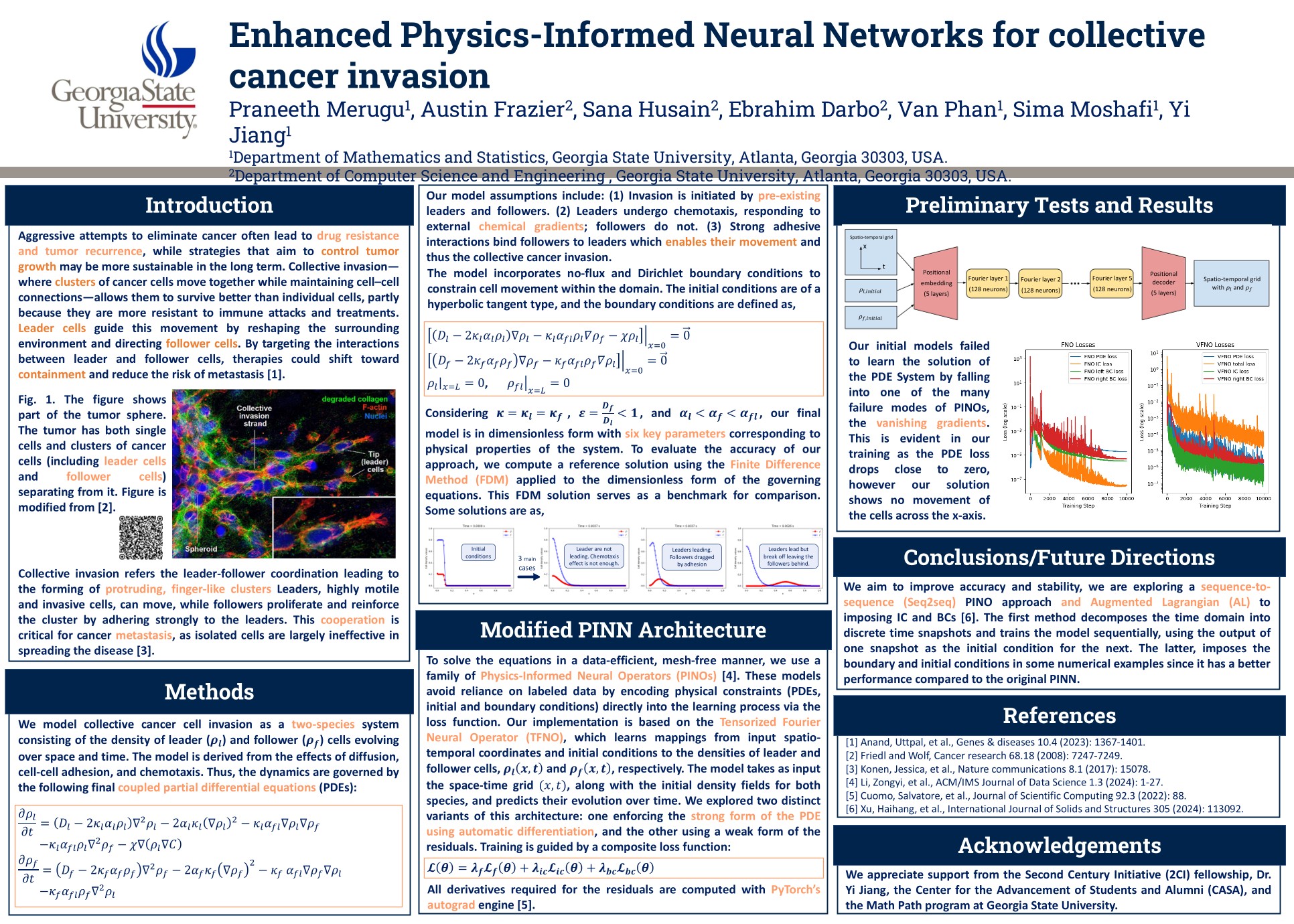
Enhanced Physics-Informed Neural Networks for Collective Cancer Invasion
| Advisor | Dr. Yi Jiang (Georgia State University) |
| Presented At / Award | • Best Project Award at Summer Undergraduate Research Symposium (SURS) 2025 |
| Code Repository | GitHub: vanthienphan2004/PINNs-Cancer-Invasion |
Abstract
Modeling collective cell migration and metastatic invasion involves complex non-linear Partial Differential Equations (PDEs) across spatial and temporal scales. Traditional numerical solvers often encounter severe discretization hurdles, mesh generation overhead, and high computational costs when fitting experimental time-lapse histology data.
To resolve these challenges, we engineered a Physics-Informed Neural Networks (PINNs) architecture tailored to simulate collective cancer invasion as a data-efficient, mesh-free continuous solver. Built on PyTorch, the framework leverages automated differentiation (autograd) to directly encode governing PDE conservation laws, boundary conditions, and initial constraints into the neural objective function, drastically minimizing requirements for densely labeled training pairs.
We further investigated advanced operator-learning methodologies, incorporating Tensorized Fourier Neural Operators (TFNO), a sequence-to-sequence (Seq2seq) Physics-Informed Neural Operator (PINO) formulation, and Augmented Lagrangian Methods (ALM). These advancements mitigate common PINN pathologies, such as gradient pathologies and optimization stiffness, ensuring stable convergence and physics-consistent parameter inference in sparse-data biomedical regimes.
Conference Poster